
FROM THE CEO: A message to our members Following Outages on Sunday, April 5, 2026
With the recent news coverage of the Northern Indiana Public Service Company (NIPSCO) lockout, Marshall County REMC (MCREMC) has received many questions and some concern about how this impacts us and our members. I want to begin by explaining how the grid works and what our working relationship is with NIPSCO.
The power grid is made up of three parts, power generation, power transmission, and power distribution.
Marshall County REMC is a not-for-profit, member owned electric distribution cooperative. Since we are a distribution cooperative, that means Marshall County REMC buys power to distribute. This structure is fundamentally different from investor-owned utilities like Duke, Indiana Michigan Power, and NIPSCO which operate as for-profit companies and own all three generation, transmission and distribution assets to supply power to their customers.
Marshall County REMC is a member-owner of Wabash Valley Power Alliance (WVPA), a generation and transmission cooperative located in Indianapolis, Indiana. WVPA is a wholesale power provider for 21 electric cooperatives located in Indiana and Illinois. Marshall County REMC has an all-power requirements contract with Wabash Valley to purchase 100% of our power that we distribute and sell to our members.
To better understand this complex network, it’s important to know that Marshall County REMC does not generate your power locally or own any generation plants whatsoever. Instead, Wabash Valley owns and operates power generation resources throughout Indiana and several other states. In most cases, when power is generated, it must be transported across long distances to get to where it will be used. This portion of the power grid is the transmission system, which consists of extremely high voltage lines needed to safely and efficiently transport power.
Wabash Valley, like most electric generation and transmission providers, does not own or operate the transmission lines solely from where the power is generated to where it is going to be used. Instead, they rely on other transmission grid owners/operators for transporting their power.
That being said, WVPA does not own or operate the transmission lines that bring the power that’s distributed by MCREMC to Marshall County. Instead, WVPA provides the electric but has contracts with NIPSCO for 100% of transportation to our cooperative. Once the power is transported it arrives at a substation/meter point to begin the distribution process.
Marshall County REMC has several delivery points, and/or substations, located throughout our service territory that are interconnected with NIPSCO transmission lines. At these substations, power is taken from the high‑voltage transmission grid and stepped down using a transformer to a lower, yet still high, distribution‑level voltage. This reduction allows electricity to be safely and efficiently distributed across our cooperative’s distribution system. At each substation, the power also passes through an electric meter jointly owned and monitored by NIPSCO and Wabash Valley Power Alliance. This meter measures the amount of electricity delivered over NIPSCO’s transmission system, which NIPSCO bills to WVPA, and WVPA in turn bills Marshall County REMC for the usage.
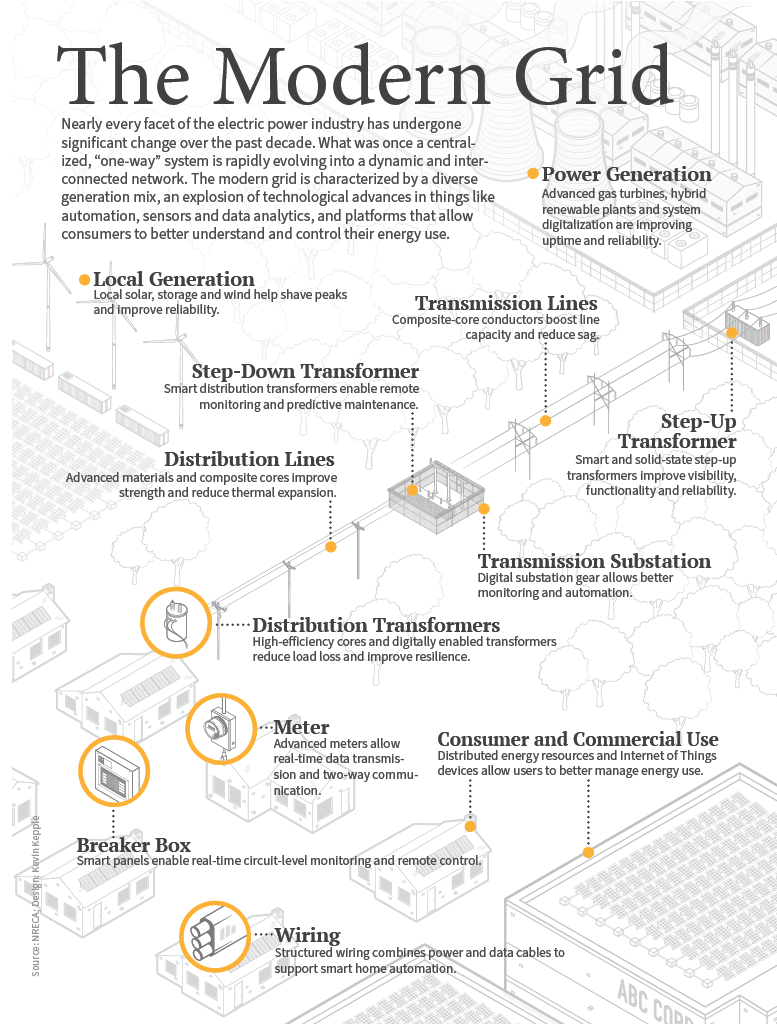
This graphic displays the parts of a modern grid from generation to the path to the home. MCREMC is a distribution cooperative and maintains and builds distribution lines only. (graphic available in larger format below)
Once that happens, the power is distributed across our system via MCREMC infrastructure and then reduced in voltage again by a smaller transformer from the distribution level down to a level that can be used in homes, on farms, and in businesses: typically, 120/240 volts. After the final voltage reduction, the electricity flows through a Marshall County REMC meter that records each member’s usage for billing.
According to local news sources, NIPSCO currently has roughly 1,600 workers locked out of work due to failed union contract negotiations affecting both transmission and distribution line workers. Until this issue is resolved, NIPSCO is coordinating with outside contract line workers to perform work and continue business continuity. Many have speculated that this situation will ultimately lead to degraded service and longer outage restoration times for NIPSCO customers due to lack of contractor knowledge of the NIPSCO system and local service territory. However, we have not experienced this with our interactions thus far.
While there has been speculation on social media, we want to clearly state that Marshall County REMC line workers—union employees represented by IBEW 1393 out of Indianapolis—will not assist NIPSCO in any capacity during this lockout. Our crews will not and have never worked on NIPSCO infrastructure, nor will NIPSCO crews work on ours. It is our understanding that work on NIPSCO infrastructure will be performed by outside contractors until the lock out is resolved.
On Sunday, NIPSCO had a damaged transmission pole off due to an auto accident that left thousands of NIPSCO and MCREMC members in the northwestern part of our county without power for several hours. The affected NIPSCO transmission circuit directly feeds the Marshall County REMC “Tyner Substation” which serves several thousand members.
Fortunately, Marshall County REMC has strategically designed and improved our distribution power grid for built-in redundancy and load switching capabilities for this exact type of outage event. Each REMC delivery point/substation is specifically located in close proximity to a NIPSCO transmission line that serves it. The ultimate goal is to have each station served by a separate line. In the event of a transmission outage, this allows MCREMC line workers to utilize other transmission feeds to backfeed all or parts of the outage area within our system, therefore getting the lights back on… as the old saying goes, don’t put all your eggs in one basket.
For the outage on Sunday, our improvements gave us switching capability from a neighboring substation that is fed off a different NIPSCO transmission line that was not impacted by the outage. MCREMC line workers immediately began performing the required load switching procedures solely within our system which allowed a large portion of our members to be restored well in advance of the NIPSCO transmission outage repair.
As CEO, I am incredibly proud of our dedicated employees who work every day to serve our members and protect the reliability of our electric system. While recent events involving NIPSCO have understandably raised questions, it is important to remember that Marshall County REMC operates independently and follows business practices that are entirely our own, always guided by what is in the best interest of our members. We sincerely appreciate our members’ patience and understanding as we continue to navigate this situation, and we remain committed to providing safe, reliable and innovative service while working through these challenges together. As always, if you have any questions or concerns, please don’t hesitate to contact our team.
Cooperatively yours,
Dave Lewallen